

By Plinio Corrêa de Oliveira
- Celebrating the month of May in a spirit of reparation
As there is no ‘Saint of the Day’ entry for today, the Committee has asked me to say a few words on how to make the most of this month, which is entirely dedicated to Our Lady, particularly in the spirit of reparation, as I have been emphasising.
It really is a very good idea, and I could suggest the following approach: this month is dedicated to Our Lady and is a month of celebrations. And naturally, out of habit and given the nature of the subject, our spirit turns to celebrating Our Lady during this month. It so happens that there is a principle of common sense, whereby one does not celebrate a person who is going through great sorrow. For example, for a mother whose child is very ill, one does not, whilst the child is ill, organise a birthday party for her. Because she is not in the right frame of mind for that.
So this is the occasion to show her veneration, affection, etc., but to show it in another way, that is, by sympathising with her pain. Say two things: I remember it’s your birthday, and I understand the happy feelings that date evokes in me, but given your state of mind and your situation, I also wanted to tell you how much it weighs on me to see you going through this ordeal, and I pray for your son’s recovery. That is what any sensible person would say.
Well, that is what we too must say to Our Lady. We must say that we remember all the enduring reasons for joy that she is to all Catholics, in all circumstances. Our Lady is in such a way causa nostrae laetitiae, as the Litany of Loreto says, that she was a cause of joy for us even in the saddest of situations, which was when Our Lord Jesus Christ died. Even on that occasion, her presence was a source of joy and comfort for us.
On the other hand, because of this, we must understand that a mere attitude of festive celebration serves no purpose, and that we must, in remembering all the joy she gives us, combine this with consideration of all the sorrow she feels in the present circumstances, and live in that sorrow. To keep that sorrow in mind. Keeping that sorrow in mind is not merely attending the Holy Day, or a ceremony, and feeling moved by it at that moment. But it is having the reasons for her sorrow at the tip of one’s tongue. And being able to recall this at any moment.
What Saint Thomas Aquinas Says About Immigration – ISFCC
And this is so easy to remember: a plot that seeks to commit the worst of crimes, after deicide, which is to lead people into error and, therefore, to attempt to destroy the Roman Catholic Church. This is a terrible crime, because nothing more nefarious can be planned against the glory of God, nothing more effective can be done against the salvation of souls; to carry out the devil’s temptation, nothing could be more fitting, for this is the very essence of the devil’s temptation. Of course, he cannot destroy the Catholic Church, because the Church is immortal. But he can, at least, take things as far as they can go along these lines. And it must be said that they are likely to go further than we imagined.
Now, this crime, set out in this way, must cause us unspeakable indignation; it must provoke a protest from our very being. For we shall love God to the extent that we hate this crime. We can test our love for God through the reaction of our soul to this crime. If, at the moment when they attempt to kill the Mystical Body of Christ, my indignation is small, there is no doubt that my love is small.
Imagine someone comes to kill me and I have a friend who says: “Oh dear, poor Dr Plínio! What a rough time he’s having right now! Anyway, let’s see how he gets out of this. I need to go and shave now.” Once I’ve recovered, he comes up to me and says: “Oh! My friend, how much I admire you!” – For heaven’s sake! I was just in the worst of trouble, and you went off to shave. You had a fit of pity for me, and you come and say you’re my friend? Where’s the consistency in that? This friendship of yours that you flaunt to me—that friendship is a mockery, it’s a mockery. Take your friendship and go; I don’t want it. A Pharisee’s friendship!
So, [the attitude we have towards] the enemies of the Church is the barometer of our love for the Church. And the hatred we feel for the crime that is being committed is the barometer of our love for Our Lady.
- Let us ask Our Lady that, through our fault, the graces she grants us are not lost
We have moved on from the idea of reparation to another idea. This consideration certainly shows how necessary reparation is. But it may also show us that our love is feeble, that our love is weak. So we should make the following request to Our Lady – someone in the Group made this request and I thought it was very beautiful; I won’t repeat the request exactly as it was phrased, but I will give it in broad terms.
And this is the request I wish to put forward: Our Lady is constantly showering the Group with graces of love for Her; but also with graces of hatred and fighting spirit against the work that the forces of darkness are carrying out against Her. Well, these graces are not being received as fully as they ought to be. Many of them fall to the ground.
So we must – those of us who are sensitive to the appeal I am making here – address the following plea to Our Lady: that She may give us all the graces that others do not make use of; that She may fill our souls with all the graces given and which others do not accept, so as to make amends for the sadness that lies in this flow of graces which goes unused; and so that at least in us the gift given to the Group may shine forth.
In the Footsteps of the Little Flower – ISFCC
And this is a beautiful prayer which I recommend to those who feel inwardly moved to do so, that they may offer it every day during the month of May. For example, at the time of Communion. To say to Our Lord, through Our Lady, that these graces may be placed in our souls, that we may be the receptacle of all combativeness, of every spirit of intransigence, of every incompatibility with evil which must characterise the true member of the ‘Catholicism’ Group. You can see that this is a splendid prayer and that we could, therefore, take it for ourselves, make it our own.
It also strikes me that it would be interesting to vary this devotion from day to day. In other words, to keep the same intention, but to dedicate each day of May to a different reflection on Our Lady. As we will be offering here, each day, a reflection on Our Lady, a piece of news about a devotion to Our Lady; one could draw from this, if you remind me, a suitable reflection for the following day, which would nourish our Rosary, our piety, for the rest of that day or the next, and which would be a way for us to make good use of the month of May, in a truly ultramontane spirit.
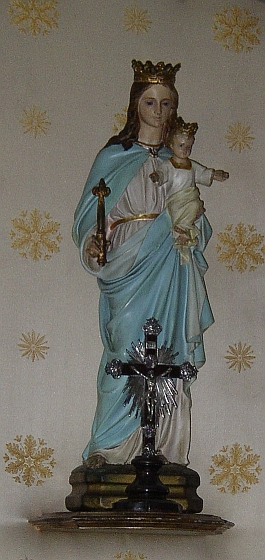
On each day of this month, I have authorised that, on the occasion of the announcement, an image or painting of Our Lady—from those held at our headquarters—be placed on display for everyone’s special veneration. Today we begin with the most venerable of our images, namely the image of Our Lady Help of Christians, which has accompanied the Group, in a sense, since its very beginnings. It is an image that belongs to me personally, but which I placed in the room of the Archdiocesan Council of Catholic Action when we were in charge of Catholic Action. When we stepped down, I removed the image, which was our property, and it was moved to [the altar of our chapel], and from then until now we have seen it accompanying us to this very day. So, this will be the first image to be venerated especially during the month of Mary.
Before moving on to the announcements, I should like to comment on an apparition of Our Lady in the city of Kiev, in Russia. As the city was under attack by the Tatars and could no longer hold out, everyone fled, abandoning everything. Saint Hyacinth of Krakow, a worthy son of Saint Dominic and a most ardent devotee of Our Lady, went to bid farewell to the statue before fleeing himself. As he commended himself to Her, he distinctly heard the alabaster statue murmur: ‘And me? Are you abandoning me? Take me with you.’ The saint did not know what to do, for the statue was extremely heavy and he could not carry it alone. But as soon as he took it in his arms, he felt it as light as a feather. The statue lost all its weight, through a miracle of the most powerful Mother of God. And naturally he fled with it.
- The manifestations of Our Lady through her images and their symbolism
You can see here in this account how Our Lady cherishes her images, how she feels worthily represented by them, and how she does not wish her images to be treated in a way that is neither worthy nor right towards her. She performed a miracle so that her image might be taken away from a place where it would likely be desecrated, etc., by heretics or anyone else who might be threatening the place.
The Holy Shroud: A Twenty-First Century Gospel – ISFCC
On the other hand, however, you can see how Our Lady loves to be with us through her images, and how she wants her images to accompany us. And so she worked a true miracle so that this image might accompany her children throughout the journey they were about to undertake. An alabaster image, extremely heavy, speaks, and yet it is easy to carry… It is a way of showing how Our Lady wishes to be present amongst her children.
Is there any application for this in our lives? If the images of Our Lady, if Our Lady so very much wants her images to be with her children, it is to make us realise how much she accompanies us through all vicissitudes, in all circumstances. Her image does not abandon us; far from it, She does not abandon us. That is to say, in whatever situations we find ourselves, in every latitude, in every longitude, at the highest peaks of the spiritual life, as well as in the saddest moments of the spiritual life, there is a gaze from Our Lady that accompanies us; there is a protection, there is a providence from Our Lady that accompanies us and never abandons us. And this should give us precisely a sense of tranquillity in the face of life’s vicissitudes.
The thought to keep in mind throughout the whole of tomorrow: Our Lady is my Mother and will not abandon me; nor does she abandon me even in the current situation, in which I so greatly need her graces—whether to make progress, to avoid falling back, or for any other reason. She does not abandon me because if an alabaster image, which after all is nothing but alabaster, goes in search of Her children, how much more so will Her providence – symbolised by the image – go in search of Her children. Our Lady will follow me like a good shepherd. And so I can have this peace of mind throughout my life: I have the protection and the watchful eye of My Mother. There is a thought for tomorrow, suggested by this devotion to Our Lady of Kiev.
This text is an adaptation of a transcript of a lecture given by Prof. Plinio Corrêa de Oliveira to members and supporters of the TFP; it therefore retains the spoken style and has not been revised by the author
This year, it is more crucial than ever that we turn to prayer and intercession to increase devotion to Our Lady across our country. That’s why you’re invited to join us in the Three Hail Marys Pledge, a powerful devotion that can bring personal spiritual benefits and national transformation. By reciting three Hail Marys daily, you honour the Immaculate Heart of Mary and seek her intercession for the conversion of sinners, the salvation of souls and the restoration of Ireland’s Catholic Faith. This ancient devotion, revealed to Saint Mechtilde, promises spiritual benefits including protection from mortal sin and the assurance of a good death. Your daily prayers will contribute to an increase in devotion to Our Lady, the conversion of sinners and the moral renewal of our country. Let us commit to this powerful devotion and seek the guidance and protection of Our Lady.